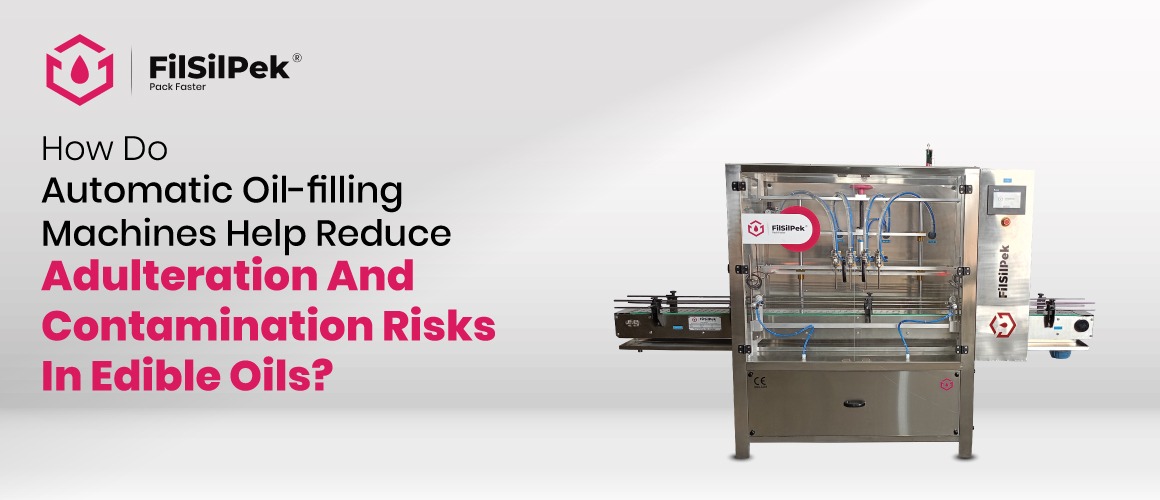
How do automatic oil-filling machines help reduce adulteration and contamination risks in edible oils?
Edible oil manufacturing operates under constant pressure to maintain product purity while meeting food safety regulations and market demand. Oils are highly sensitive products any unwanted mixing, residue carryover, or exposure to contaminants during filling and packaging can directly impact quality, shelf life, and consumer health. As production volumes increase, manual and semi-automatic methods often become weak links in quality control.
Automatic oil-filling machines address these risks by converting oil handling into a controlled, closed, and monitored process. Instead of relying on operator judgment at each step, these systems apply predefined parameters and validated workflows, helping manufacturers maintain consistent quality across batches and production shifts.
This article explains why adulteration and contamination are major concerns in edible oil processing, how automatic oil filling machines technically reduce these risks, and how these capabilities can be applied effectively across industrial oil production and packaging facilities.
Why is controlling adulteration and contamination in edible oils so important?
Adulteration in edible oils often occurs through deliberate mixing of lower-cost oils or accidental cross-contact between different oil types. Even small quantities of foreign oil can change the fatty acid profile, smoke point, and nutritional value of the final product. Such deviations may not be visible but can be detected during laboratory analysis, leading to batch rejection or regulatory action.
Contamination risks are equally serious and usually stem from environmental exposure, residues left in transfer lines, or poor sanitation of filling equipment. Dust particles, metal fragments, or microbial growth can enter oil when open handling or inconsistent cleaning practices are followed. Since oils are widely used in cooking, any contamination can have a widespread consumer impact.
From a compliance perspective, food safety authorities expect documented process control, hygienic equipment design, and full traceability. Failure to demonstrate control over filling and packaging stages can result in audits, penalties, or recalls. For manufacturers supplying retail chains or export markets, consistent contamination control is not optional it is a basic requirement for business continuity.
How do automatic oil-filling machines reduce adulteration and contamination risks?
Automatic oil-filling machines are engineered to maintain strict control over product movement, dosing, and sealing. Their design reduces exposure points and enforces process discipline through automation and monitoring.
- Closed-loop product transfer architecture
Automatic systems use sealed tanks, sanitary pumps, and enclosed pipelines to move oil from storage to filling heads. This closed-loop design prevents airborne contaminants from entering the product stream and eliminates opportunities for unauthorized additions during transfer. - Reduction of manual intervention points
In automated lines, operators are not involved in pouring, measuring, or topping up containers. Their role is limited to supervision and parameter selection, which significantly lowers the chance of accidental contamination or intentional adulteration during filling operations. - Recipe-driven process control for different oil types
Each edible oil variant such as refined sunflower, groundnut, or blended oils can be assigned a dedicated filling recipe. These recipes control flow characteristics, container size compatibility, and changeover sequences, reducing cross-contamination during product switches. - High-accuracy volumetric or mass-based dosing systems
Automated fillers use calibrated flow meters or servo-driven piston systems to dispense consistent volumes. Any deviation from expected fill values can indicate abnormal behavior, such as dilution or line blockage, triggering immediate inspection. - Integrated clean-in-place functionality
Built-in CIP systems circulate cleaning and sanitizing solutions through all product-contact surfaces. These cycles follow validated time, temperature, and flow parameters, reducing residue buildup and preventing microbial growth between production runs. - Automated sealing and closure integrity control
Filling machines often integrate capping, induction sealing, or tamper-band application units. Uniform and verified sealing prevents post-filling contamination and provides visible evidence if a container has been interfered with after packaging. - Batch identification and production data capture
Automatic systems generate batch codes linked to production parameters such as date, time, oil type, and machine settings. This data supports traceability and helps isolate issues quickly if quality deviations are detected later. - Real-time monitoring and fault response mechanisms
Sensors continuously track flow rates, pressure levels, and fill consistency. When readings exceed defined limits, the system can alert operators or halt production automatically, preventing compromised oil from entering downstream packaging or distribution.
Best practices for using automatic oil filling systems in the edible oil industry
In edible oil processing, even minor handling gaps can affect oil purity, stability, and regulatory compliance. Automatic oil filling systems must be aligned with oil-specific process conditions such as viscosity variation, temperature sensitivity, and grade segregation. When these systems are operated with well-defined procedures, they help maintain consistent quality across refined, blended, and specialty edible oils. The following practices focus specifically on applying automated filling systems effectively within edible oil manufacturing and packaging environments.
- Segregate transfer lines or apply validated changeover cleaning protocols for different edible oil grades and blends.
- Lock oil-specific filling recipes to prevent incorrect parameter selection during shift changes.
- Validate clean-in-place cycles to ensure complete removal of oil residues that may cause cross-mixing.
- Calibrate flow meters and mass-based fillers to account for viscosity changes across oil types.
- Control operator access to filling and recipe settings using role-based permissions.
- Monitor temperature conditions at filling points to maintain oil stability and flow consistency.
- Integrate batch coding with raw material and finished goods traceability systems.
- Inspect seals, gaskets, and filling nozzles for oil residue buildup that can attract contaminants.
- Train operators on edible oil hygiene risks and food safety handling requirements.
- Review filling and sanitation logs regularly to detect early signs of deviation or cross contact.
Conclusion
Automatic oil filling machines play a central role in reducing adulteration and contamination risks by replacing manual handling with controlled, data-driven processes. Their closed transfer paths, automated cleaning, and monitored dosing systems create a reliable barrier against both intentional and accidental quality issues.
For edible oil manufacturers, this translates into safer products, stronger compliance records, and higher confidence from buyers and regulators. With proper implementation and disciplined operation, automation becomes a long-term safeguard for oil purity and brand integrity.
To explore advanced oil filling solutions tailored for industrial edible oil applications, connect with our experts at [email protected].
How dairy retail chains can manage multi-size SKUs with automatic ghee filling machines?
For dairy retail chains, offering ghee in various pack sizes has become …
How does liquid filling automation ensure safety and accuracy in chemical labs?
Chemical laboratories work with a broad spectrum of substances—acids, solvents, reagents, and volatile..
How Are Herbal Extract Producers Using Automatic Fillers for Glass Bottles and Droppers?
Herbal extract producers are under increasing pressure to meet demand…