
Material innovations: biodegradable spout pouches & caps
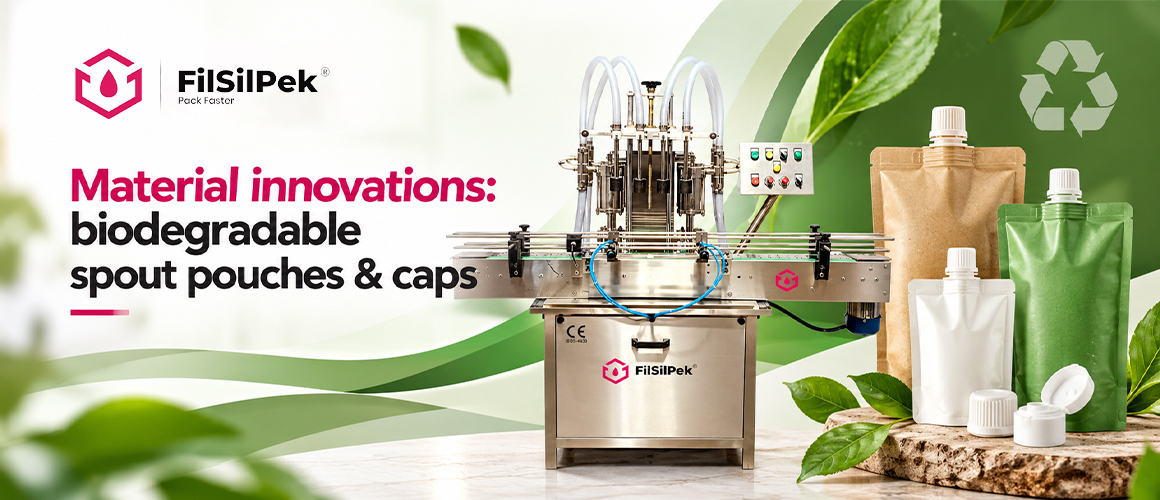
Explore biodegradable spout pouches and caps, including material innovations, packaging performance, and end-of-life considerations for sustainable packaging.
Introduction
Context and market shift toward sustainable packaging
You’re observing a clear move toward sustainable packaging in consumer goods. Brands pursue solutions that reduce waste, lower carbon footprints, and support environmental responsibility. Flexible packaging often uses less material and saves space in transit and on shelves.
Spout pouches and their caps are emerging as leading options. They offer portability, reseal ability, and controlled dispensing while aligning with sustainability goals. The focus remains on food safe, recyclable, or biodegradable materials and designs that enable end‑of‑life recovery.
Overview of spout pouches and caps in eco-friendly design
Spout pouches, or stand-up spout bags, pair a flexible form with a built‑in spout and cap. They deliver strong shelf impact and convenient dispensing for liquids, pastes, and gels, while supporting a lower material footprint than rigid containers.
Caps come in various types to suit different applications, including screw caps, flip‑tops, child‑resistant caps, and tamper‑evident variants. Eco‑friendly design emphasizes recyclable or compostable cap materials and sealing methods that maintain integrity with minimal waste.
- Barrier properties help preserve shelf life while enabling mono‑material options where feasible.
- Material choices span multi‑layer laminated films and evolving mono‑material solutions to improve recyclability.
- Design decisions balance performance, cost, and environmental impact for sustainable packaging programs.
Biodegradable Spout Pouches: Materials and Performance
Biopolymer blends and compostable films
Biopolymer blends combine renewable polymers to create flexible packaging that can be composted or biodegraded at end of life. They are tuned for processability, heat seal strength, and barrier performance to maintain shelf life while supporting sustainable disposal options.
Compostable films are engineered to break down under defined conditions while preserving product integrity. They employ certified additives and surface treatments to resist pinholes and ensure reliable seals, enabling safe dispensing without compromising food safety.
Barrier properties and shelf-life considerations
Barrier performance remains essential when using biodegradable formulations. Engineers optimize oxygen and moisture barriers to extend freshness, exploring mono material and laminated configurations that improve recyclability where feasible.
Understanding how barrier layers interact with spout geometry, cap fit, and fill level helps ensure consistent performance from production to consumer use, with shelf life tied to the material system and storage conditions.
Biodegradable Caps for Spout Pouches
Biodegradable and recyclable cap materials
Caps should align with the pouch’s sustainability goals while preserving process compatibility. Biodegradable caps break down under controlled conditions, and recyclable options keep the end-of-life loop intact. Focus is on ensuring compatibility with existing spout designs and production lines.
Materials include biopolymer blends and recycled polymers that retain rigidity, threading, and reseal ability. Caps endure repeated use without compromising seal strength. When feasible, cap polymers are selected to align with the pouch material to support recycling streams.
Sealing performance and user experience
Seal integrity remains essential for cap development. Technologies like ultrasonic spout insertion and heat-welded inserts deliver robust closures that resist leakage during transport and handling. Cap design also shapes dispensing control, from reseal ability to smooth opening.
- Cap types influence dispensing: screw caps, flip-top, and tamper‑evident variants.
- Spout position interacts with cap geometry to optimize flow and pour accuracy.
- Child‑resistant and resealable options balance safety with usability.
Design Innovations That Drive Sustainability
Mon material packaging for end-of-life recovery
Mon material constructions simplify recycling streams by harmonizing the pouch film with the cap material. When they match, facilities can recover the packaging as a single material, reducing contamination and processing steps. This approach supports recyclability without sacrificing barrier performance where possible.
Clear labeling and streamlined sorting are benefits of mono material designs, contributing to a packaging system that remains robust while advancing environmental outcomes for sustainable packaging programs.
Lightweighting and reducing material usage
Weight optimization trims pouch and cap mass without sacrificing seal integrity or dispensing performance. Techniques include adjusting film gauge, refining spout geometry, and eliminating redundant layers where feasible. The result is a lower carbon footprint across production, transport, and disposal.
In addition to weight, designers use micro engineering to preserve barrier properties with thinner films. This sustains shelf life while driving material efficiency and supporting responsible decision making across the product lifecycle.
Lifecycle and End-of-Life Scenarios
Biodegradation versus recycling streams
Biodegradation offers end-of-life options when packaging reaches defined environments such as controlled composting or industrial digestion, reducing landfill burden.
Recycling preserves material value by keeping the pouch and cap in circular loops. Mono-material designs ease sorting, while laminated structures may require specialized processing to recover polymers without compromising safety.
- Mono-material options can improve recyclability or compostability depending on local infrastructure.
- Barrier integrity must be maintained during end-of-life processing to prevent contamination.
- Clear labeling guides consumers to the correct disposal stream.
Take-back programs and circular economy considerations
Take-back initiatives connect brands, recyclers, and consumers to close the loop. Programs encourage returning used pouches and caps for material recovery where feasible.
Data tracking in circular models supports provenance, sorting accuracy, and post-consumer flow. Collaboration across supply chains ensures material compatibility, consistent quality, and scalable processing.
- Partnerships with recyclers align material specs with local sorting capabilities.
- Standardized labeling accelerates consumer participation in take-back efforts.
- Lifecycle assessments inform choices on materials and end-of-life pathways.
Applications Across Industries
Food and beverage launch benefiting from spout pouches
Spout pouches deliver portion control, reliable dispensing, and reseal ability, with spouts positioned to optimize pour precision while maintaining product integrity.
Mono-material constructions simplify downstream processing and support clearer labeling for end users, enhancing recyclability without compromising barrier performance.
- Juices, smoothies, and dairy alternatives benefit from easy dispensing and tamper‑evident caps.
- Fruit purées, baby foods, and sauces require dependable barrier performance for short to medium shelf life.
- Powdered drink mixes and ready‑to‑use blends leverage resealable caps to preserve freshness between uses.
Non-food applications and multipurpose use cases
Spout pouches address household and personal care need where precise dosing or controlled release matters. Compatible dispensing systems support broad category adoption.
Durable barrier films and heat‑welded inserts provide leak resistance during transit, making pouches viable for liquids such as detergents, cosmetics, and cleaners while aligning with environmental targets.
- Industrial and home care liquids can use tamper‑evident and child‑resistant caps where safety is essential.
- Cosmetics benefit from laminates that showcase content while preserving stability.
- Multipurpose formats enable refills, reducing waste and advancing sustainability goals.
Manufacturing and Supply Chain Implications
Material sourcing and supplier collaboration
Engage suppliers early to align biopolymer blends with end‑of‑life pathways and local recycling capabilities. This alignment helps ensure consistent performance and reduces risk across the supply chain.
Maintain traceability for film thickness, barrier performance, and material provenance to support sustainability claims and compliance.
- Mono-material options simplify downstream processing and recycling.
- Barriers must be validated for compatibility with spout and cap configurations.
- Long‑term supply agreements stabilize pricing and material availability.
Processing, converting, and quality control
Control is key for maintaining seal integrity and barrier performance. Temperature management and laminating parameters influence spout and cap fit, so tight process discipline matters.
Converters must handle film thickness variability without compromising fit and performance of spouts and crowns. Real‑time QC ensures defects are caught before packaging runs.
- In‑line inspection sensors verify seal strength and cap fit during production.
- Material handling protocols minimize particulates that could affect lamination adhesion.
- Documentation tracks resin to finished pouch, supporting traceability.
Regulatory and Standards Landscape
Biodegradability standards and labeling
Biodegradability standards vary by region, shaping how spouts and caps are tested and marketed. Brands must align with local definitions to avoid greenwashing.
Labeling communicates end-of-life pathways, including compostability, recyclability, and any certification marks. Clear wording helps consumers choose the correct disposal route.
- Regional standards define composting timelines and conditions.
- Certification bodies verify claims through standardized tests.
- Labels reflect applicable end-of-life options for the market.
Compliance considerations for packaging materials
Materials must satisfy safety and performance criteria for food contact. Compliance covers chemical restrictions, migration limits, and barrier properties.
Cross-border supply chains require checks for compatibility, traceability, and labeling accuracy. Audits and documentation support regulatory due diligence.
|
Aspect |
Considerations |
Impact |
|
Food safety |
Food contact compliance; migration limits |
Ensures safety and market access |
|
Labeling |
End-of-life and material declarations |
Builds trust and avoids penalties |
|
Certifications |
Biodegradability, compostability, recyclability proofs |
Validates sustainability claims |
FAQs
- What makes spout pouches biodegradable or recyclable?
Biodegradable or recyclable spout pouches are made using mono-material laminates or specially formulated barrier films designed for specific end-of-life pathways. These materials reduce packaging complexity while supporting improved recyclability or biodegradability.
- Do biodegradable films have a shorter shelf life?
Not necessarily. Certain biodegradable and recyclable films are engineered to provide effective barrier protection. However, shelf life depends on factors such as the product type, viscosity, storage conditions, and the selected film structure.
- Can the cap and spout be recycled with the pouch?
Yes, depending on the materials used and the recycling facilities available in your area. Using compatible cap and pouch materials, along with appropriate packaging design, can help improve recyclability.
- How does pouch design affect recyclability?
Packaging design plays an important role in recyclability. Mono-material structures can simplify sorting and recycling processes while maintaining essential properties such as seal strength, product protection, and ease of use.
- What processing steps ensure spout and cap integrity?
Proper spout insertion, precise heat sealing, and controlled processing conditions are essential for maintaining package integrity. Techniques such as ultrasonic spout insertion and heat-welded inserts require accurate temperature, pressure, and alignment control to help prevent leakage.
|
Topic |
Key Considerations |
Practical Impact |
|
End-of-life |
Mono-material options, proper labeling, take-back programs |
Improved recyclability and consumer clarity |
|
Safety |
Food contact compatibility, seal integrity |
Maintains product safety and regulatory compliance |
|
Performance |
Barrier protection, cap fit, spout alignment |
Reliable dispensing and extended product life |

Adapting Filling Lines for High Viscosity Cosmetic Products
You are selecting a filling….
Filling & sealing innovations for ready to eat sauces and condiments
You’re entering a space where….

Augmented reality for remote troubleshooting & service
Augmented reality transforms field….
Contact Us
Address
B-603, SHALIN SQUARE HATHIJAN CIRCLE VATVA G.I.D.C ROAD, VINZOL,AHMEDABAD-382445 GUJARAT
Contact
+91 90542 94961
Inquiry Form
Contact Us
Address
B-603, SHALIN SQUARE HATHIJAN CIRCLE VATVA G.I.D.C ROAD, VINZOL,AHMEDABAD-382445 GUJARAT
Contact
+91 90542 94961
Inquiry Form
Contact Us
Address
B-603, SHALIN SQUARE HATHIJAN CIRCLE VATVA G.I.D.C ROAD, VINZOL,AHMEDABAD-382445 GUJARAT
Contact
+91 90542 94961
Inquiry Form
Contact Us
Address
B-603, SHALIN SQUARE HATHIJAN CIRCLE VATVA G.I.D.C ROAD, VINZOL,AHMEDABAD-382445 GUJARAT
Contact
+91 90542 94961
Inquiry Form
Contact Us
Address
B-603, SHALIN SQUARE HATHIJAN CIRCLE VATVA G.I.D.C ROAD, VINZOL,AHMEDABAD-382445 GUJARAT
Contact
+91 90542 94961
Inquiry Form