
Human-Robot Collaboration: How Cobots Are Transforming Material Handling & Palletizing
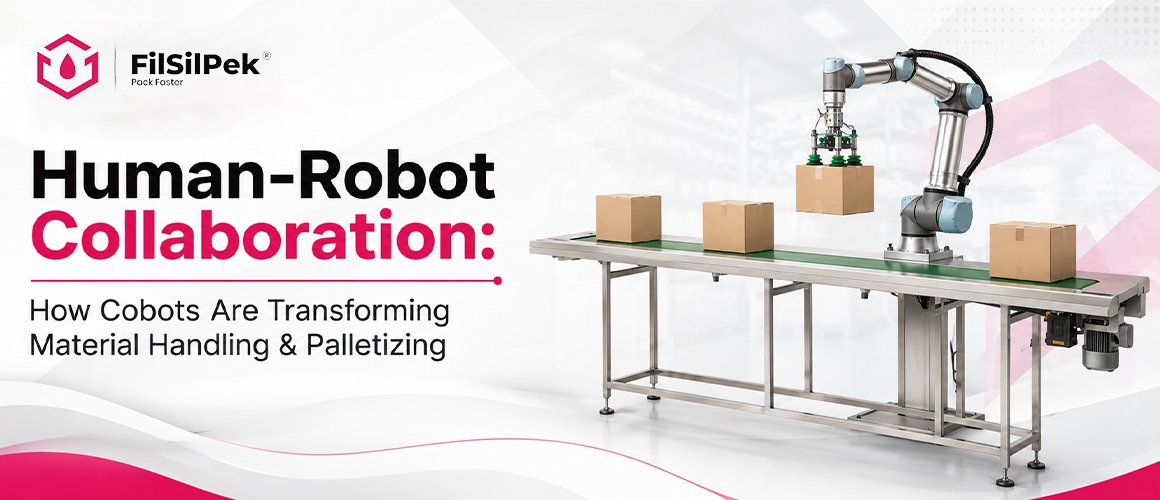
A practical guide to deploying human-robot collaboration for loading, palletizing, and warehouse operations — what they do, how they’re implemented, and how to measure ROI.
Introduction
Warehouses and distribution centers face a familiar squeeze: rising order volumes, thinner labor pools, and pressure to cut injury rates without slowing throughput. Collaborative robots — cobots — have become one of the most practical answers to that squeeze, particularly in material handling and palletizing.
Unlike traditional industrial robots, which run in caged, fenced-off cells, cobots are engineered to work in the same physical space as people. Built-in force sensing, speed limiting, and vision systems let them slow down or stop the instant a person enters their path. That single design difference is why cobots have spread so fast in warehouses: they don’t require a full facility redesign to install.
This guide covers where cobots fit in a material handling operation, how palletizing deployments actually work, what the safety requirements look like, and how to evaluate ROI before you commit budget.
What Is a Cobot, exactly?
A cobot (collaborative robot) is a robotic arm designed to operate near or alongside human workers without the physical guarding that traditional industrial robots require. Key characteristics:
- Force and torque sensing — the arm detects unexpected contact and stops or retracts
- Speed and separation monitoring — some systems slow down as a person approaches, rather than stopping outright
- Lightweight, rounded design — reduces injury severity in the event of contact
- Fast reprogramming — many cobots can be “taught” a new motion path by hand-guiding the arm, without writing code
This is different from a fully autonomous mobile robot (AMR), which moves through a facility, or a traditional palletizing robot, which is typically fenced and runs at higher speed with no direct human interaction.
Where Cobots Fit in Material Handling
- Loading and Unloading
Cobots pick items from incoming totes, bins, or pallets and place them onto conveyors, racks, or staging areas. This is one of the highest-injury tasks in a warehouse (repetitive lifting, awkward reaches), which makes it a common first deployment.
- Palletizing and Depalletizing
This is the single most common cobot use case in distribution. A cobot builds a stable pallet layer by layer, following a programmed pattern (full-pallet, mixed-SKU, or single-SKU), and can typically switch between patterns in under a minute through a teach pendant or software interface.
- Bin Picking and Sorting
Using 2D or 3D vision, cobots identify and grasp items from unstructured bins — a task that used to require heavy custom tooling and is now increasingly handled with off-the-shelf vision-guided grippers.
- Case Packing and Conveyor Transfer
Cobots move product between conveyor lines, into shipping cases, or onto pallets at a fixed cadence, synchronized with upstream and downstream equipment via PLC integration.
- Quality Inspection
Camera-equipped cobots check dimensions, labels, and surface defects in-line, diverting flagged items to a rework or reject lane without stopping the main flow.
How a Cobot Palletizing Cell Actually Works
A typical cobot palletizing deployment has four components:
|
Component |
Function |
|
Robot arm |
Executes pick-and-place motion; payload typically 10–35 kg for warehouse use |
|
End-of-arm tooling (EOAT) |
Vacuum grippers, mechanical grippers, or clamp tooling matched to box/product geometry |
|
Vision or sensing system |
Confirms box presence, orientation, and placement accuracy |
|
Pattern software |
Generates the stacking pattern (interlocking layers, column stacking, etc.) based on box dimensions and pallet size |
The cobot receives a case from the infeed conveyor, confirms its dimensions (either from a barcode scan or vision check), and places it according to the pre-built pattern. When a layer is complete, the software calls for a slip sheet or signals the layer change. When the pallet is full, the cobot (or an adjacent AMR) signals for pallet exchange.
Typical deployment timeline: a single-cell palletizing pilot usually takes 2–6 weeks from installation to stable production, depending on SKU variability and integration complexity with existing conveyors.
Safety Standards and Risk Assessment
Cobot deployments still require a documented risk assessment — “collaborative” does not mean “unregulated.” In most jurisdictions, cobot integration is guided by standards such as:
- ISO 10218-1/-2 — safety requirements for industrial robots and robot systems
- ISO/TS 15066 — technical specification covering collaborative robot operation, including force and pressure limits for contact with a human
- ANSI/RIA R15.06 — the U.S. equivalent framework for industrial robot safety
A proper risk assessment identifies pinch points, evaluates whether a given task qualifies for hand-guiding or speed-and-separation monitoring versus full power-and-force limiting, and documents the safeguarding decisions. Even “safe by design” cobots need this on file — auditors and insurers will ask for it.
Practical safety measures that show up in real deployments:
- Floor markings and light curtains around high-speed zones (even collaborative cells often run at reduced-but-nonzero speed for throughput)
- Defined re-start procedures after an e-stop or fault, including a cooldown before the arm resumes motion
- Logged maintenance and calibration checks, typically monthly
- Operator training on safe zones, hand signals, and lockout/tagout procedures
Calculating ROI: What to Actually Track
Cobot ROI conversations often stall on vague promises. Here’s what to measure instead:
- Cycle time before vs. after — units per hour on the automated task
- Labor reallocation, not labor elimination — where did the freed-up hours go (usually: quality checks, exception handling, other lines)?
- Injury and workers’ comp claims on the specific task before and after
- Reject/rework rate on palletized loads (shifted or damaged pallets during transport)
- Changeover time between SKUs or pallet patterns
Most single-cell cobot deployments in material handling report payback in 12–24 months, with faster payback on tasks that had high injury rates or overtime costs before automation. That range varies a lot with labor cost, shift count, and how much integration work was needed — treat any faster promise with some skepticism until you’ve run your own pilot numbers.
Implementation Roadmap
Step 1 — Pick one task, not a whole line. Choose a repetitive, high-volume task with predictable geometry (e.g., palletizing one SKU) for the pilot.
Step 2 — Run a 2–4-week pilot. Track cycle time, error rate, and any near-miss safety events.
Step 3 — Validate tooling. Confirm the end-of-arm tooling holds grip across your actual product range, not just the pilot SKU.
Step 4 — Document the risk assessment. Don’t skip this even if the integrator says the cobot is “inherently safe.”
Step 5 — Train operators on the new workflow, including what to do during a fault, not just how to load the cell.
Step 6 — Expand deployment to adjacent tasks or lines once the pilot metrics hit target, using the same tooling and software platform where possible to avoid re-training staff from scratch.
Frequently Asked Questions
Do cobots replace warehouse workers? Rarely as a net reduction. Most deployments reassign workers from the automated task to supervision, exception handling, or other lines rather than eliminating headcount outright.
How much does a cobot palletizing cell cost? Hardware and integration for a single-arm palletizing cell commonly falls in the $50,000–$150,000 range depending on payload, tooling complexity, and conveyor integration — though pricing varies significantly by region and integrator.
Do cobots need safety cages? Not always. Whether guarding is required depends on the risk assessment — speed, payload, and the specific task determine if physical barriers, light curtains, or purely software-based limits (speed/force monitoring) are sufficient.
What’s the difference between a cobot and an AMR? A cobot is a stationary (or cart-mounted) robotic arm that manipulates objects. An AMR (autonomous mobile robot) moves through the facility transporting goods. Many deployments use both together — an AMR delivers pallets to a cobot palletizing cell.
Is vision required for palletizing cobots? Not for fixed, single-SKU patterns, but vision becomes important for mixed-SKU pallets or when box dimensions vary, since it lets the cobot confirm placement and catch misfeeds without manual reprogramming.
Conclusion
Cobots have moved from novelty to standard equipment in material handling because they solve a specific, measurable problem: repetitive, injury-prone tasks that don’t require human judgment but do require consistency. The deployments that succeed share a pattern — a narrow pilot, a documented safety process, and metrics tracked from day one rather than assumed. Facilities that skip the risk assessment or scale before validating tooling are the ones that see poor ROI within the first year, not the ones that pilot carefully first.

Enhancing operator training with augmented reality support
So, can augmented reality actually make operator training better? The short answer is a…..

Ozone and UV sterilization in filling machines
When it comes to keeping your filling machines clean and your products safe, ozone and UV…..

Integrating blockchain for full traceability in food & chemical packaging
Integrating blockchain into food and chemical packaging isn’t just a…..
Contact Us
Address
B-603, SHALIN SQUARE HATHIJAN CIRCLE VATVA G.I.D.C ROAD, VINZOL,AHMEDABAD-382445 GUJARAT
Contact
+91 90542 94961
Inquiry Form
Contact Us
Address
B-603, SHALIN SQUARE HATHIJAN CIRCLE VATVA G.I.D.C ROAD, VINZOL,AHMEDABAD-382445 GUJARAT
Contact
+91 90542 94961
Inquiry Form
Contact Us
Address
B-603, SHALIN SQUARE HATHIJAN CIRCLE VATVA G.I.D.C ROAD, VINZOL,AHMEDABAD-382445 GUJARAT
Contact
+91 90542 94961
Inquiry Form
Contact Us
Address
B-603, SHALIN SQUARE HATHIJAN CIRCLE VATVA G.I.D.C ROAD, VINZOL,AHMEDABAD-382445 GUJARAT
Contact
+91 90542 94961
Inquiry Form
Contact Us
Address
B-603, SHALIN SQUARE HATHIJAN CIRCLE VATVA G.I.D.C ROAD, VINZOL,AHMEDABAD-382445 GUJARAT
Contact
+91 90542 94961
Inquiry Form